EU Regulation 168/2013 is the legal backbone for how quadricycles are built, tested, and approved for sale across Europe. It sets the type-approval and market-surveillance framework for all L-category vehicles (from mopeds to quadricycles), replacing the older directive system and harmonising rules across Member States.
What the regulation actually does
- Defines the L-categories (L1e–L7e) and the criteria that put a four-wheeled vehicle into L6e (light quadricycle) or L7e (heavy quadricycle).
- Specifies how vehicles get EU type-approval, so a model approved in one country can be registered in another.
- Delegates detailed technical rules to a set of companion acts covering functional safety, construction, emissions/propulsion, and admin templates.
L6e vs L7e: the headline limits
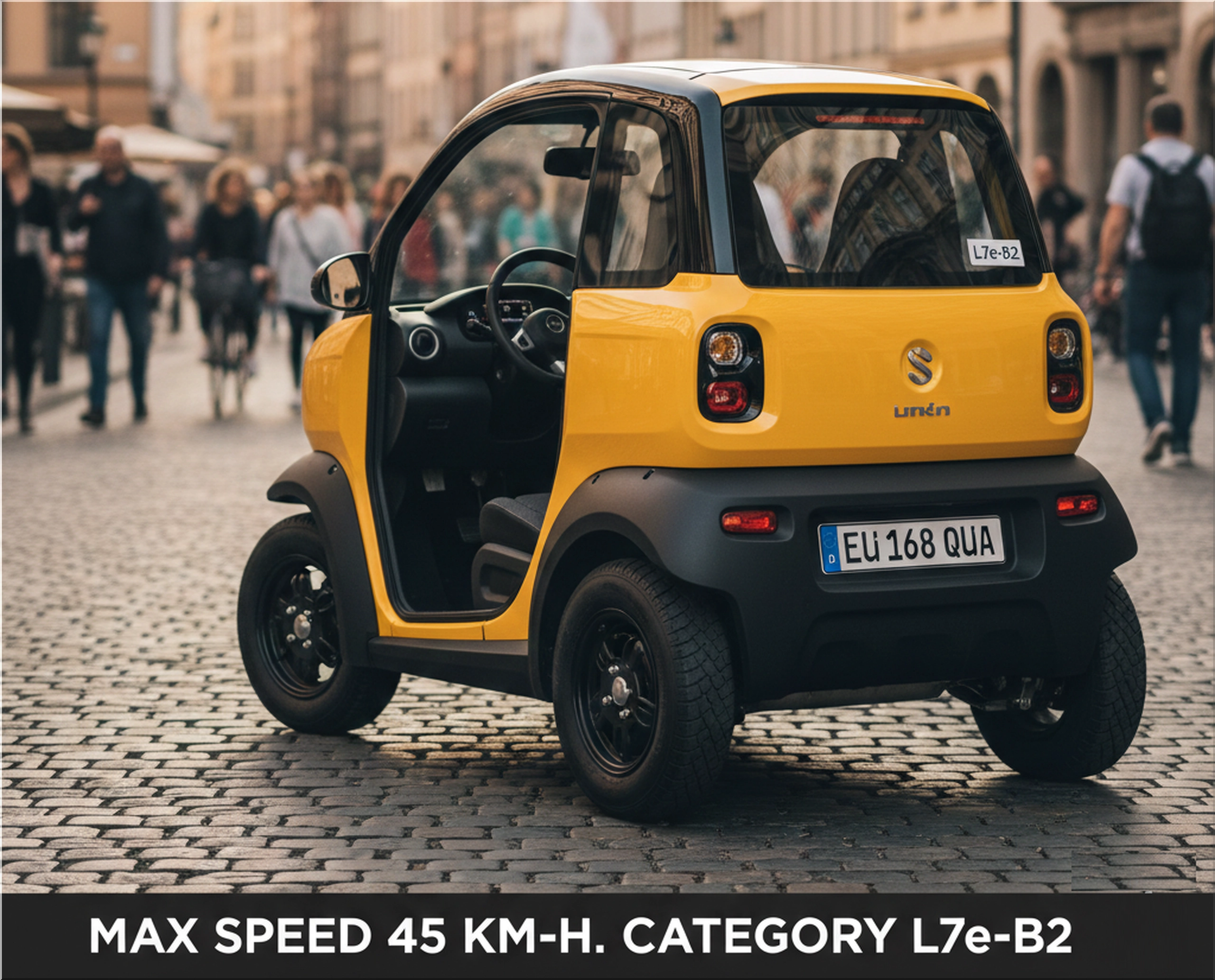
L6e — Light quadricycles (the 45 km/h class)
- Max design speed: 45 km/h
- Mass in running order: ≤ 425 kg
- Power limits (sub-classes):
- L6e-A (light on-road quad): ≤ 4 kW
- L6e-B (light quadri-mobile): ≤ 6 kW (with an enclosed compartment)
- Seats: typically up to two
These thresholds make L6e ideal for dense-city use and entry-level licensing in many countries.
L7e — Heavy quadricycles (up to 15 kW)
- Unladen mass caps: ≤ 400 kg (passenger) or ≤ 550 kg (goods), excluding the battery for EVs
- Max continuous rated power: 15 kW
- Speed: not tied to the 45 km/h cap (national road-access rules still apply)
L7e vehicles feel closer to microcars and suit mixed urban/suburban routes.
The full sub-category map (why it matters for buyers)
Understanding sub-classes helps you read spec sheets and check licence/insurance rules.
- L6e-A: light on-road quads (open), ≤ 4 kW.
- L6e-B: light quadri-mobiles (enclosed), ≤ 6 kW, split into:
- L6e-BP: passenger focus (max two seats).
- L6e-BU: utility/goods (must meet a minimum load-bay volume).
- L7e-A: heavy on-road quads (A1 straddle-seat with handlebar, A2 non-straddle seats).
- L7e-B: heavy all-terrain quads.
- L7e-C: heavy quadri-mobiles (CP passenger up to four non-straddle seats; CU utility up to 600 kg mass-in-running-order).
The rulebook behind the rulebook (the 4 companion acts)
Regulation 168/2013 is the framework; the technical detail lives in four acts you will see quoted on spec sheets and CoCs:
- 3/2014 — Functional safety: braking, steering, stability, occupant protection basics.
- 44/2014 — Vehicle construction & general requirements: lighting, mirrors, doors, glazing, dimensions, etc.
- 134/2014 — Environmental & propulsion performance: emissions/evap (for ICE), OBD, durability; relevant to Euro steps.
- 901/2014 — Implementing/admin requirements: templates, marking, certificates, and process rules.
Euro emissions steps for L-category: later amendments applied Euro 5 / 5+ staging to L-category with key dates from 2020 for new types, and administrative updates to the 901/2014 templates.
Weight terms decoded (EV buyers, read this)
- Unladen mass (L7e): excludes the traction battery for electric vehicles. This is why a heavy EV quadricycle can list 400/550 kg unladen yet carry a sizeable pack.
- Mass in running order (L6e/L7e tables): typically includes fluids and standard equipment and is the basis for the 425/450/600 kg limits you will see in national guidance.
What Regulation 168/2013 does not cover
- Driver licensing and road access. The EU sets the vehicle rules; who can drive where is set nationally. Motorway use, ring-roads, or minimum-speed road bans come from your country or city.
Quick reference: L6e vs L7e thresholds
| Criterion | L6e (light) | L7e (heavy) |
|---|---|---|
| Max speed | 45 km/h | Above 45 km/h possible (national rules apply) |
| Power limit | 4 kW (L6e-A) / 6 kW (L6e-B) | 15 kW |
| Mass basis | ≤ 425 kg mass in running order | ≤ 400 kg (passenger) / 550 kg (goods) unladen, EV battery excluded |
| Typical body | Open or enclosed (quadri-mobile) | On-road quad, all-terrain quad, or quadri-mobile |
Sources for the table: consolidated L-category classification tables and the Alternative Fuels Observatory definition set.
Practical implications for shoppers and fleets
- Match class to route: 30–50 km/h urban grids suit L6e; mixed corridors and higher-speed connectors point to L7e.
- Spec checks that matter: doors and heating (winter), lighting/defogging, tyre size/availability, and whether the model is L6e-B (6 kW) or L6e-A (4 kW).
- Paperwork: ask the dealer for the EU type-approval number and CoC; these reference the delegated/implementing acts above.
- Emissions step (ICE) & OBD: if the model has an engine, confirm Euro 5 compliance; for EVs/hybrids, check the declared OBD/propulsion requirements in the approval.
Frequently asked questions
Is 45 km/h a hard limit for all quadricycles?
No. Only L6e is capped at 45 km/h. L7e can be faster, but national access rules still decide where you can drive.
Why do some spec sheets list weight without the battery?
Because unladen mass for L7e excludes the traction battery on EVs. That keeps EVs eligible even with heavier packs.
Where did these rules come from?
Regulation 168/2013 (15 January 2013) replaced the older directive framework and is updated via delegated/implementing acts. (Regulation (EU) No 168/2013 of the European Parliament, Directives and regulations on two- and three-wheel vehicles and quadricycles).
Documents:
- 922 views