Battery specs look simple until you try to use them. One listing shouts a big number in kWh. Another highlights voltage. A third brags about charging time, but never says at what power. If you want to buy (or live with) a quadricycle confidently, you need to translate battery jargon into three real questions:
- How far will it go on your routes?
- How fast will it recharge where you actually park?
- How will the battery age over 2 to 5 years?
This guide breaks down kWh, voltage, and the supporting specs that decide daily usability.
The 60-second cheat sheet
If you only remember five things, remember these:
- kWh = energy capacity (think: size of the fuel tank).
- kW = power (think: how fast you spend energy or how fast you can charge).
- Voltage affects current (higher voltage usually means less heat and easier power delivery).
- Wh/km (or kWh/100 km) predicts range better than kWh alone (think: efficiency).
- Usable capacity matters more than advertised capacity (you cannot always access every last percent).
Pro-Tip: When comparing two quadricycles, do not start with range claims. Start with usable kWh and typical Wh/km for your speed and weather. Range becomes math, not marketing.
kWh explained: the battery's size in plain language
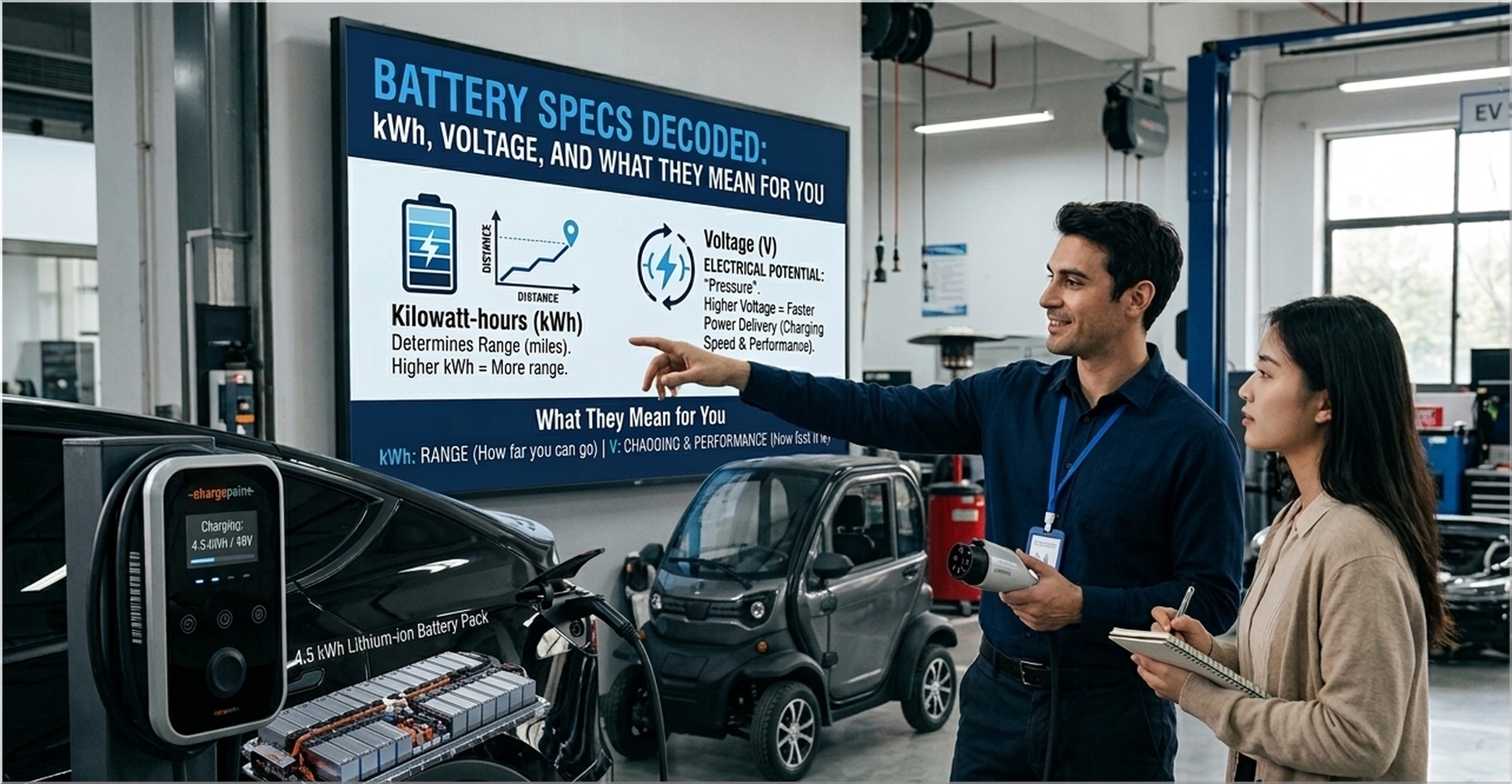
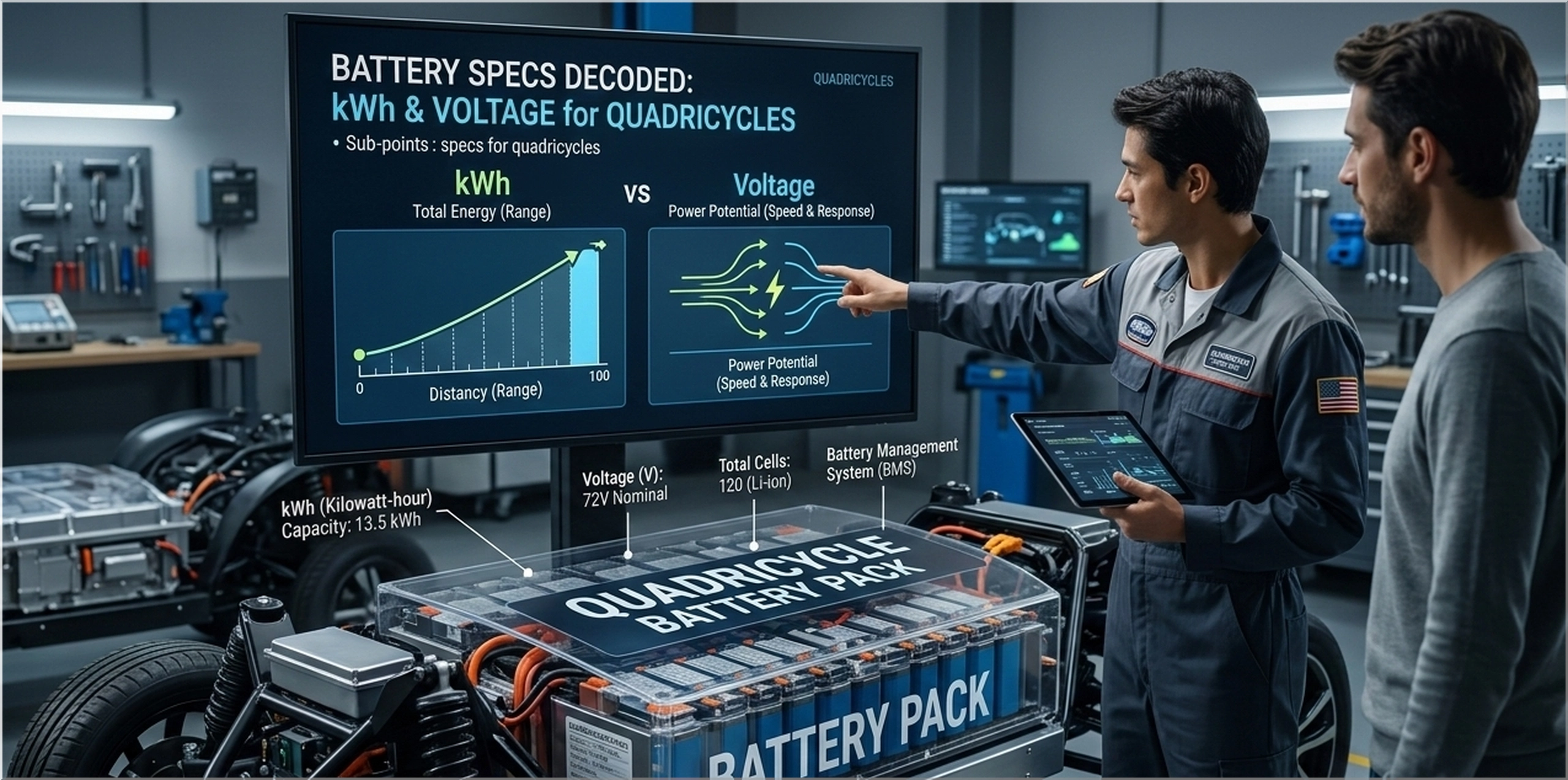
kWh (kilowatt-hours) measures how much energy the battery can store. Bigger kWh usually means more range, but only if efficiency stays similar.
Gross vs usable kWh
Manufacturers and listings may show:
- Gross capacity: total energy stored in the pack.
- Usable capacity: energy you can actually use for driving.
Why the difference? Batteries keep a buffer at the top and bottom to reduce stress and improve longevity.
A simple range estimate
Use this quick equation:
- Estimated range (km) = Usable kWh ÷ (Wh/km ÷ 1000)
Example:
- Usable: 5.0 kWh
- Efficiency: 70 Wh/km
- Range: 5.0 ÷ (70/1000) = about 71 km
Real life will vary, but this puts you in the right neighborhood fast.
Voltage: why it matters even if you never touch a cable
Voltage tells you how the battery system pushes energy through the vehicle. You do not "feel" voltage directly while driving, but it influences several things that show up in daily use.
What higher voltage can improve
- Lower current for the same power (less heat, less loss)
- More efficient power delivery under load (hills, acceleration)
- Easier high-power charging in designs that support it
What voltage does not guarantee
Voltage alone does not mean fast charging. Many quadricycles remain limited by:
- Onboard charger power
- Charging connector and cable limits
- Local outlet limits where you park
Definition: Current (amps) is the flow. Voltage is the push. Power (kW) is the result:
kW = volts × amps ÷ 1000
Ah (amp-hours): the missing piece that connects voltage and kWh
Some spec sheets list Ah. It helps when kWh is not clearly stated.
Use this relationship:
- Wh = volts × Ah
- kWh = (volts × Ah) ÷ 1000
Example:
- 72 V battery, 100 Ah
- Wh = 72 × 100 = 7200 Wh
- kWh = 7.2 kWh
Pro-Tip: If a listing gives voltage and Ah but hides kWh, you can still compare fairly.
kW: the number that controls speed feel and charging time
kW shows up in two places. Confusing them is the fastest way to buy the wrong quadricycle.
Motor power (driving performance)
- Higher motor kW usually means stronger acceleration and better hill-climbing.
- L6e and L7e classes cap power differently, so kW also signals what category you are in.
Charging power (refueling speed)
- Charging kW controls how fast you refill the battery.
- A small battery with low charging power can still feel convenient if you plug in often.
Pro-Tip: For city life, charging power is often more important than top speed. A vehicle that adds meaningful range per hour at home feels effortless.
Real-world range: why speed and temperature dominate
Range claims assume gentle driving and mild weather. Your real range depends on how quickly your quadricycle burns energy.
Big range killers
- Higher steady speeds (wind resistance rises fast)
- Cold temperatures (battery chemistry slows, cabin heating adds load)
- Hills and stop-start climbs
- Low tyre pressure
- Carrying extra weight
- Constant max-speed driving in a 45 km/h L6e
Quick planning rule
- For predictable commuting, aim for daily distance + 30% buffer.
- In cold climates, treat the buffer like a requirement, not a suggestion.
Charging decoded: from household sockets to public posts
Most quadricycles win on simplicity: plug in at home, wake up charged. Still, charging time only makes sense when you know the power source.
Household charging: the most common reality
Typical outlets deliver roughly 1.4 to 2.3 kW depending on the current limit and safety settings.
Use this estimate:
- Charge time (hours) = Usable kWh ÷ Charging kW + 10–20% losses
Examples:
- 5.0 usable kWh at 2.0 kW = 2.5 hours + losses = about 3 hours
- 10.0 usable kWh at 2.0 kW = 5 hours + losses = about 6 hours
Onboard charger: the hidden limiter
Even if a public point can deliver more, the vehicle can only accept what its onboard charger supports (for AC charging).
AC vs DC (what to expect in quadricycles)
- AC charging: common, simple, slower, best for overnight.
- DC fast charging: rare in many quadricycles, more common in larger EVs.
Pro-Tip: If you cannot charge at home or work, prioritize a model that reliably works with the charging options on your exact route. Convenience beats theoretical capability.
Battery aging and health: what protects your investment
Batteries wear mainly from heat, high state-of-charge, and deep cycling. You can dramatically improve longevity with a few habits.
Practical habits that help
- Keep daily charging in a mid-range when possible (instead of always 100%).
- Avoid letting the battery sit empty for long periods.
- Park in shade or indoors during extreme heat.
- Drive smoothly when cold for the first few minutes.
- Follow the manufacturer guidance for storage and long idle periods.
What to ask when buying used
- Battery state of health if available
- Charging pattern (mostly slow AC vs frequent high-power charging)
- Any warning lights or reduced performance
- Service history and software updates
Definition: State of health (SOH) is a percentage estimate of remaining usable capacity compared to new.
What specs matter most for L6e vs L7e buyers
Different classes reward different priorities.
If you are shopping L6e (45 km/h)
Prioritize:
- Usable kWh that covers daily distance + buffer
- Charging convenience (household socket compatibility, cable length)
- Weather practicality (doors, demist, wipers)
- Efficiency at 30–45 km/h (Wh/km)
De-prioritize:
- Big top-speed numbers (you are capped anyway)
- Performance upgrades that complicate insurance
If you are shopping L7e (faster, more flexible)
Prioritize:
- Speed headroom for ring roads and connectors (where allowed)
- Stability and noise at 60–90 km/h
- Usable storage if it is your daily driver
- Charging power if you drive more km per day
De-prioritize:
- Massive battery size if you cannot charge conveniently
FAQs
Does bigger kWh always mean more range?
Usually, but not always. A heavier or less efficient vehicle can burn more Wh/km and reduce the advantage.
Why do two quadricycles with similar batteries have different ranges?
Efficiency differs due to weight, tyres, aerodynamics, gearing, and how the motor controller is tuned.
Is voltage a performance spec?
Indirectly. Higher voltage can support higher power with lower current, but motor tuning and controller limits still decide how it feels.
What is the single most useful spec for buyers?
Usable kWh plus a realistic Wh/km estimate for your speeds and weather.
What now? Your buyer checklist
- Write your daily round trip and your fastest road segment.
- Set a buffer: +30%, and more if winters are cold.
- Estimate required usable capacity:
- Usable kWh needed = (daily km × Wh/km) ÷ 1000
- Confirm you can charge where you park: outlet type, access, and typical hours plugged in.
- Compare models using the same three numbers:
- Usable kWh
- Charging kW where you will charge
- Wh/km at your typical speed
- 149 views